Teammates E-Portfolio: https://emelinemcdaniel.quarto.pub/emeline-mcdaniel/
Project Summary & Skills Used
For my final project in INEG 26103 – Introduction to Operations Research, my teammate Emeline McDaniel and I developed an optimization model designed to improve the travel logistics of four SEC baseball teams during the 2025 season: Arkansas, Missouri, Ole Miss, and Tennessee. While SEC baseball travel may seem straightforward, the reality is that teams frequently move between states for three-game weekend series and midweek matchups, creating dense travel schedules that influence transportation cost, rest, fatigue, and fairness across programs. As described in our project documentation, the goal of our model was to minimize total travel cost while also managing athlete fatigue and ensuring no team experiences an excessive travel burden relative to others OR Final Project. We built a multi-objective model that treats each scheduled event as a node in a travel network, allowing decisions regarding transportation mode (bus vs. charter flight), departure times, arrival times, and whether overnight rest is required.
Developing this system required a combination of skills learned throughout the course, including mathematical modeling, linear and integer programming, network flow concepts, constraint formulation, data acquisition, and the ability to translate real-world considerations into solvable mathematical structures. Beyond the technical skills, this project strengthened my ability to justify modeling assumptions, work collaboratively on a shared codebase, and communicate results to both technical and non-technical audiences.
Project Development Process
Our project evolved significantly over time. Initially, we planned to model SEC football travel, but we discovered that football schedules lacked sufficient complexity for meaningful optimization work. As explained in our documentation, football games occur only once per week, meaning far fewer travel arcs and less opportunity to model fatigue, scheduling density, or fairness issues. Because of this, we shifted the scope from football to baseball, whose multi-game weekends and midweek trips create a much richer modeling environment OR Final Project.
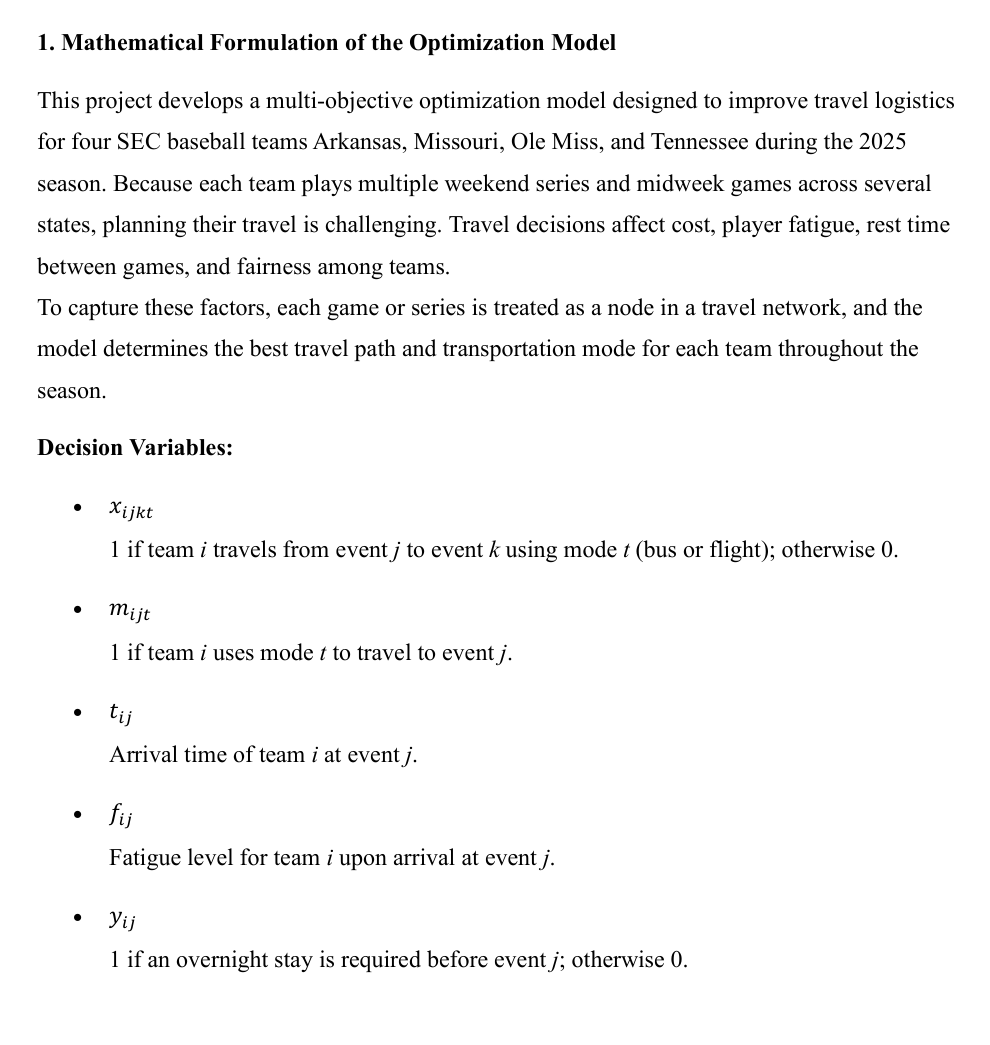
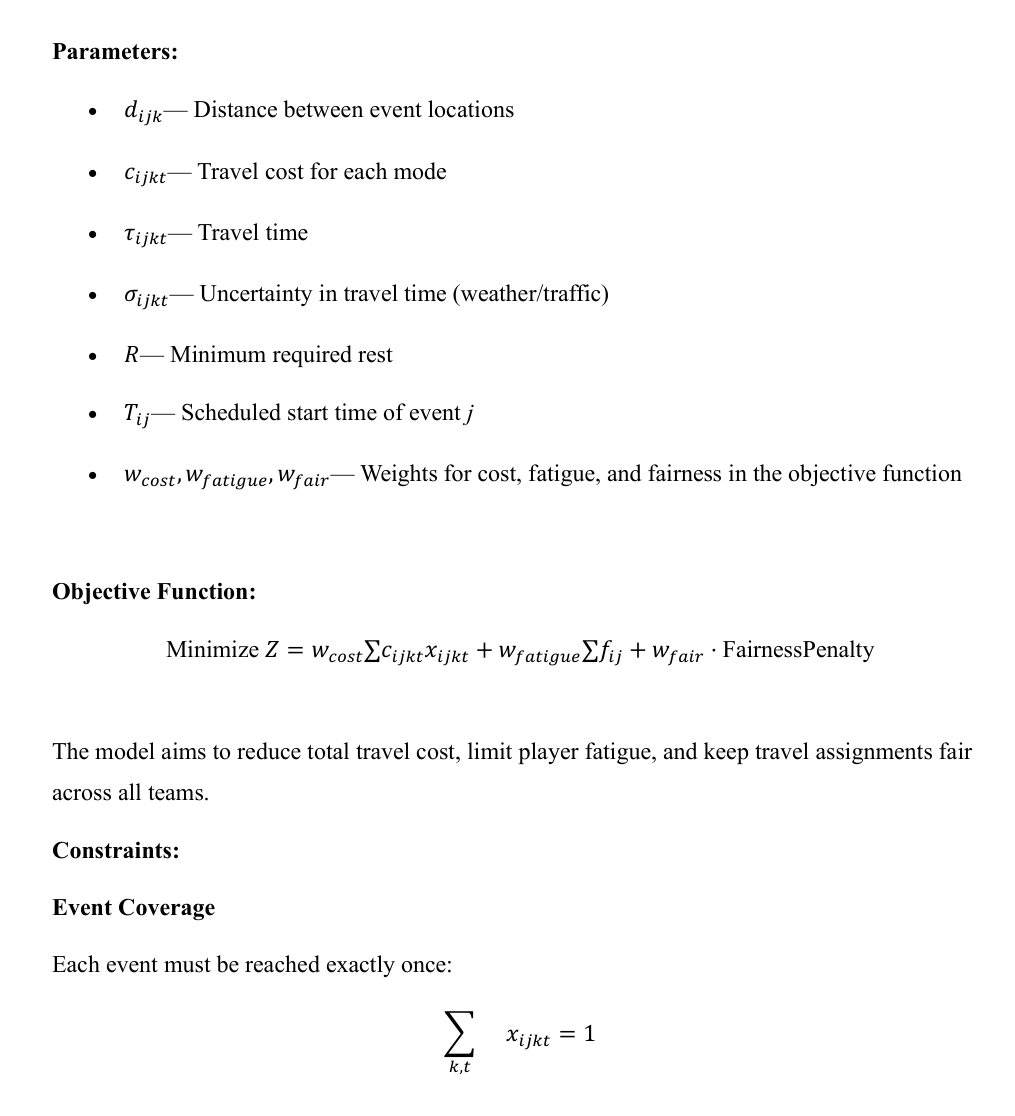
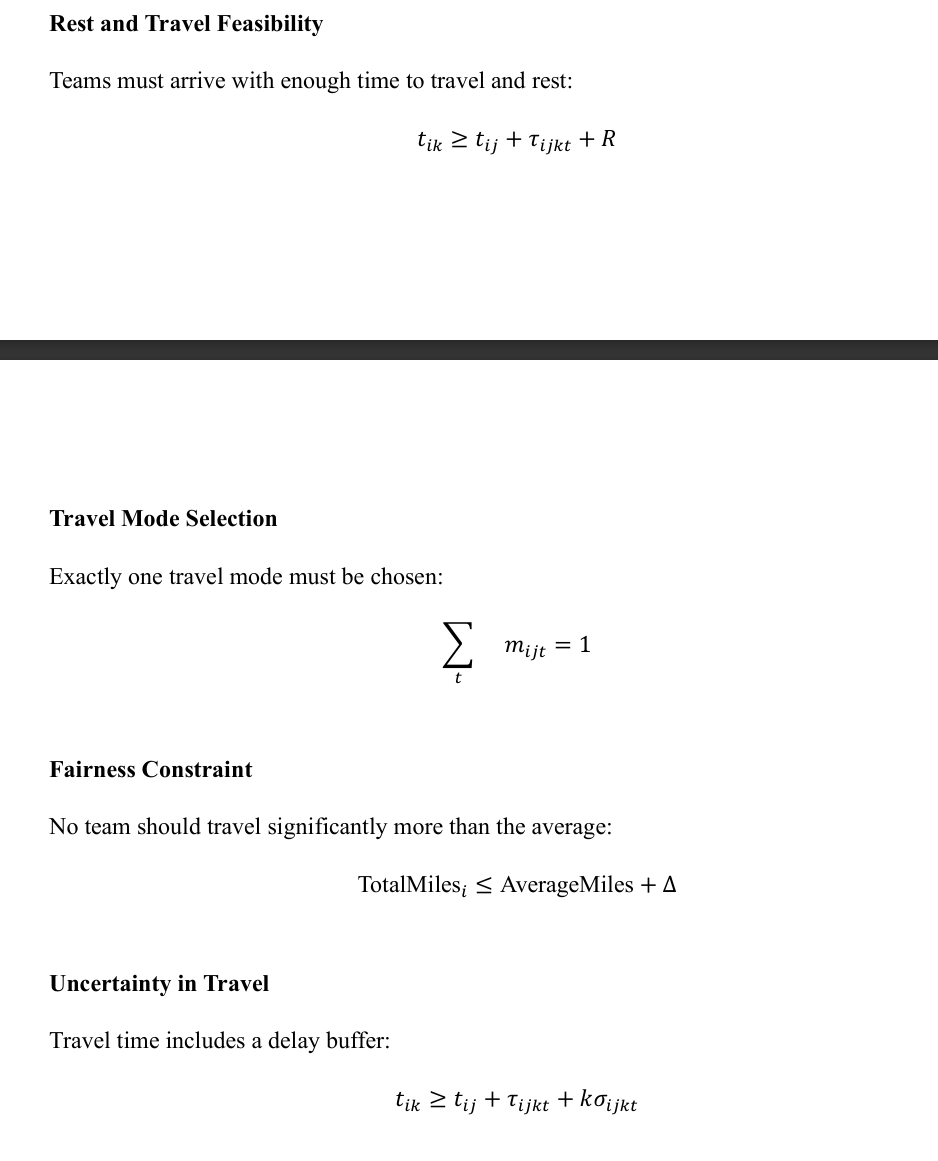
Our next idea was to model all 16 SEC baseball teams; however, the sheer size of the network made this unrealistic for the project timeline. Instead, we strategically selected four teams Arkansas, Missouri, Ole Miss, and Tennessee because they are geographically diverse and still produce a sufficiently complex travel network. Once the scope was set, we collected real schedule data, stadium coordinates, Google Maps distance matrices, flight-time estimates, charter pricing, and rest-related parameters from NCAA guidelines. A major roadblock emerged when attempting to model fatigue realistically. Fatigue is not a simple, measurable value; it varies by player, depends on travel time and mode, and accumulates based on how tightly games are scheduled. After experimenting with several ideas, we settled on a simplified fatigue model that increases with travel time and decreases with rest, making it both intuitive and solvable OR Final Project.
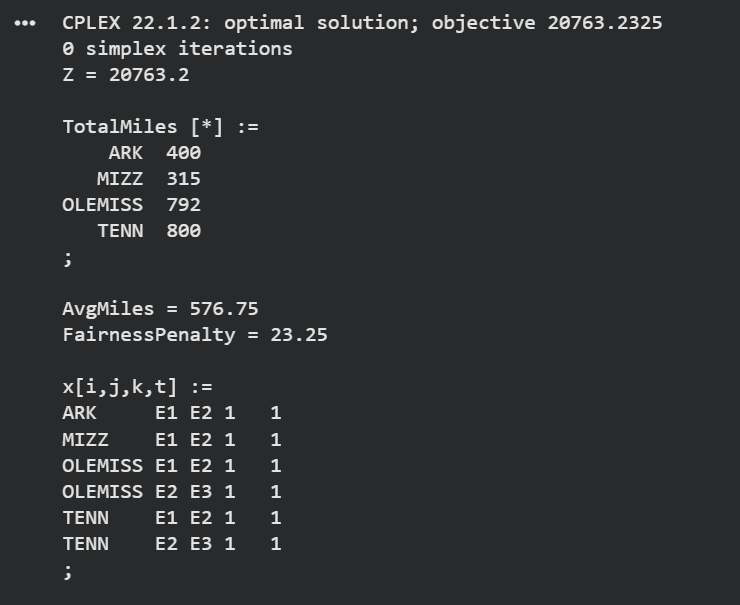
Throughout the development process, we built a sequential flow network where each event connects to the next, requiring the model to optimize the entire season at once rather than making isolated trip-by-trip choices (presentation, page 4). This structure allowed for more holistic decision-making and revealed interesting fairness gaps such as Tennessee traveling nearly twice as many miles as Arkansas and Missouri in our test schedule (presentation, page 9).
Key Features or Highlights
One of the most important features of our model was its ability to choose between bus and flight transportation. When we ran our baseline cost-minimization model, the optimization overwhelmingly selected buses for every trip because buses are significantly cheaper per mile. As illustrated in our final results (presentation, page 7), the model defaulted to bus travel across all legs of the season, emphasizing why adding competing objectives like fatigue and fairness is essential if the goal is more than simple cost savings. This result also confirmed that our cost data and objective function were functioning correctly.
Another major highlight was the ability to evaluate fairness across teams. Our model computed total miles traveled per team and applied a fairness penalty when a team exceeded the average by a certain threshold Δ. According to our graphical results (presentation, page 9), Tennessee’s assigned travel under the test schedule was nearly double that of Missouri and Arkansas, demonstrating how real SEC scheduling can create hidden inequities. This gave us strong evidence that fairness needs to be considered explicitly when designing schedules or planning travel.
Finally, the model’s framework is highly extensible. As discussed in our proposal and presentation, it could easily scale to include all 16 SEC teams, incorporate limits on charter aircraft availability, integrate weather-based uncertainty scenarios, and support alternative scheduling structures such as regional pods. This flexibility shows the strength of operations research methods in structuring complex travel-planning systems with multiple conflicting objectives.
Reflection
This project significantly deepened my understanding of operations research and optimization modeling. One of the biggest lessons I learned was how difficult it can be to model human-centered factors such as fatigue. Distance and cost are straightforward to quantify, but fatigue depends on many subjective variables. Time of day, travel mode, sleep quality, recovery rates, and the density of scheduled games. In our documentation, we noted that no standardized formula exists for fatigue in college athletics, and grappling with that uncertainty forced us to make thoughtful, justified approximations rather than oversimplifying the problem or overwhelming the model with unnecessary complexity. Designing this component helped me appreciate the balance between realism and solvability in OR modeling.
Collaboration was also a key part of this project. Emeline and I divided responsibilities, shared insights on model structure, and worked together to troubleshoot errors. I am proud of the work I contributed especially in structuring the multi-objective model, helping transition the project from football to baseball, ensuring data consistency, and refining the fairness and fatigue components. Through this project, I gained confidence in my ability to translate a real scheduling challenge into a mathematical model, justify assumptions, and interpret results in a meaningful way. I also strengthened my skills with AMPL, optimization logic, teamwork, and technical communication.
Overall, this project showed me how powerful operations research can be in improving real-world decision-making systems. It gave me a strong foundation in model formulation, exposed me to the challenges of human-centered modeling, and helped me grow both technically and professionally. I now feel much more confident in my ability to build OR models from scratch and explain them clearly to others.